Novira App
2026
Helping first-time investors move from intention to action.
Role Product designer
Timeline 4 weeks
Team Solo
Skills Product Design UX Research Prototyping
Overview
I spent years "learning" about investing without ever investing.
The more I learned, the more I realized the problem wasn't access to information. It was the uncertainty that came before making a decision.
As I explored beginner investor communities, behavioral economics, and existing investment platforms, I noticed many others shared the same hesitation.
Novira is my attempt to design for that moment.
Instead of assuming users already know how to invest, it focuses on helping first-time investors build enough confidence to take the first step.

The Problem
People avoid investing because they lack confidence to..... just start.
While researching beginner investors, I noticed the same pattern appearing everywhere. People asked questions like:
"What if I lose my money?"
"I've watched so many videos and still don't know where to begin."
"How do I know I'm making the right decision?"
These conversations weren't isolated. They appeared repeatedly across beginner investing communities.

Context
I did some findings using behavioral economics
Behavioral economics explains why.
People don't make financial decisions purely through logic.
Loss aversion makes potential losses feel more painful than equivalent gains.
Present bias makes delaying investment feel easier than starting today.
Choice overload makes having dozens of options harder, not better.
I also looked closely at products like Risevest, Cowrywise, and Bamboo.
One insight kept resurfacing. People don't necessarily fear investing. They fear making irreversible mistakes.
That changed the way I approached the experience; I designed around reducing uncertainty. That became the product problem.
How might we help first-time investors move from intention to action?
The Opportunity
Design an investing experience that encourages the users to take action.
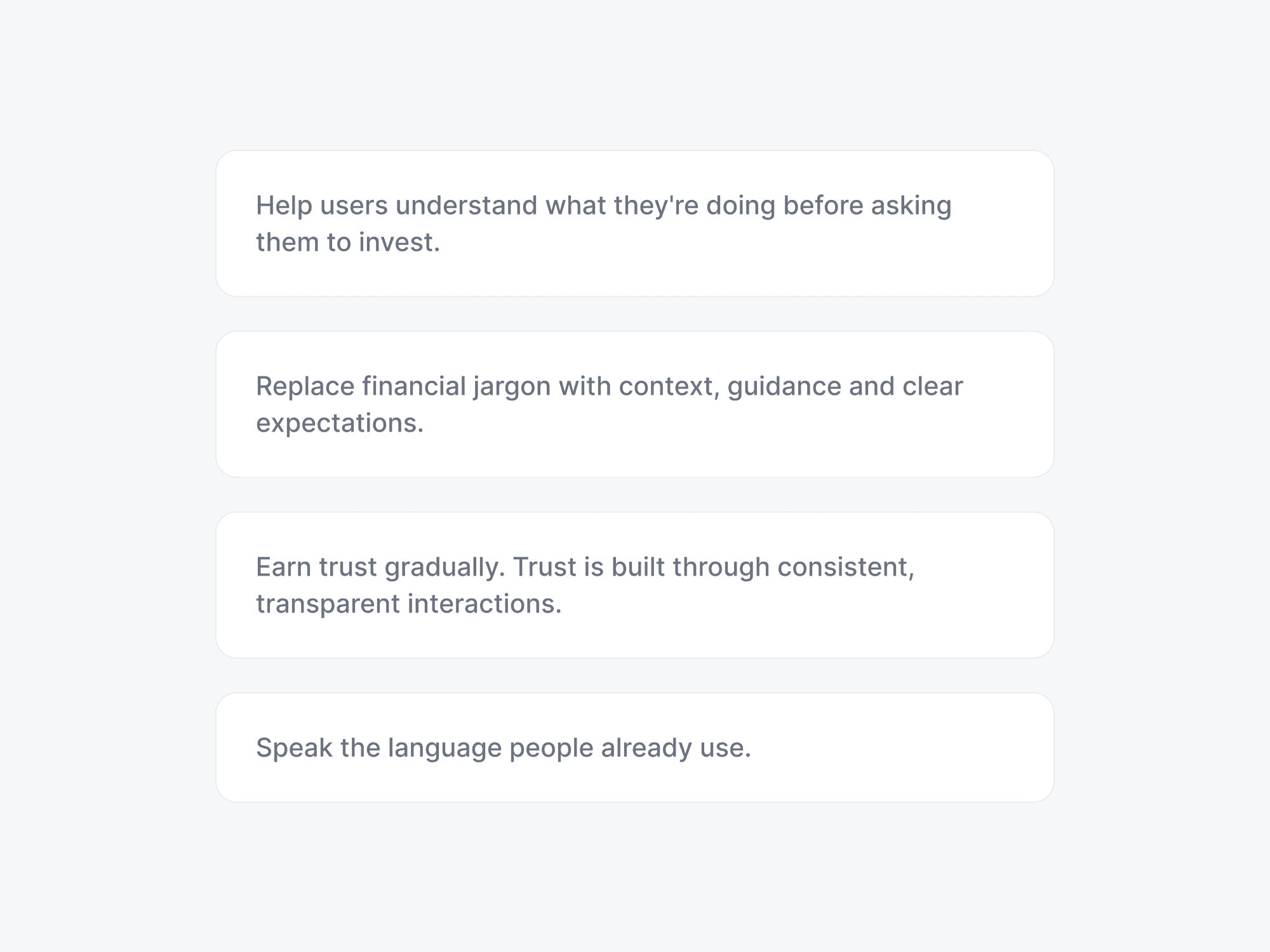
Every major decision in Novira is guided by five principles.
Instead of "build a portfolio," people want to save for rent, emergencies or starting a business.
These principles became the foundation for every interaction in the product.
Solution
Novira helps first-time investors start with confidence.
Rather than leading with financial products, Novira leads with understanding.
The experience gradually helps users learn, build confidence, receive a personalized recommendation, and invest when they're ready.
From onboarding to portfolio recommendations, every interaction is designed to answer questions, reduce uncertainty, and make investing feel approachable.
Core Flows
Onboarding
Novira is a behavioral-first investment platform designed for first-time investors.
Instead of asking users to figure out investing on their own, the product guides them through understanding their risk profile, funding their wallet, creating goal-based investment plans, and tracking their progress.
Investment
Discover your investment profile
Instead of asking,
"How much risk can you tolerate?"
users answer behavioral questions based on realistic scenarios.
The result is a personalized investor profile that recommends appropriate investment products.
This reduces decision fatigue while helping beginners feel guided rather than overwhelmed.
Wallet
Fund your wallet
I designed the flow to minimize uncertainty by clearly communicating:
supported payment methods
minimum funding amount
processing state
success confirmation
The prototype uses variables and conditional logic to create a more realistic interaction, including editable inputs and validation states.
Investment
Create an investment plan
Rather than investing into abstract financial products, users invest towards goals like Rent, Emergency Buffer or Starting a Business, with projected returns shown before committing.
In this example, the goal is Save for Rent.
The flow guides users through:
naming the goal
choosing a target amount
selecting a target date
reviewing projected growth
funding the plan
The emphasis is on helping users understand what they're committing to before asking them to commit.
Design System
Rather than picking colors screen by screen, I built a token architecture with two layers: raw color primitives (Brand), and a semantic layer (Alias) that gives each primitive a job. Nothing gets used directly; every color a screen shows is a named role, not a hex code.
Two token systems, deliberately kept separate.
Novira has both an asset-class color system (used in allocation charts; Real Estate, Fixed Income, Money Market, Growth Stocks each get a fixed, meaningful color) and a product-icon color system (used on browse cards and success illustrations).


Other screens
The final product explores much more than the three prototyped journeys.
Additional flows include:
Profile completion
Identity verification
Fixed-income investments
Goal editing
Portfolio management
Wallet management
Transaction history
Early withdrawal
Multi-currency support
Light and Dark mode
These experiences share the same design system, interaction patterns and behavioural principles established in the core journeys.
After investing, users can monitor their portfolio, track progress toward their goals, top up existing investments, and explore new opportunities.
Performance is presented in a way that feels understandable rather than intimidating, encouraging long-term investing instead of short-term reactions.


Testing & Iteration
A prototype only matters if someone else can test it.
Before finalizing the experience, I asked a few friends to use the prototype.
Some of the improvements that came from those sessions included:
Making investment recommendations easier to understand.
Simplifying parts of the onboarding flow.
Improving the clarity of projections before investing.
Below is the previous prototype before the feedbacks
Reflection
few lessons for me:
Research only becomes valuable when it changes product decisions.
Trust is built through a combination of multiple interactions.
Explaining before asking reduces hesitation better than simplifying after confusion.
People don't need more financial information; they need enough clarity to take the first step.